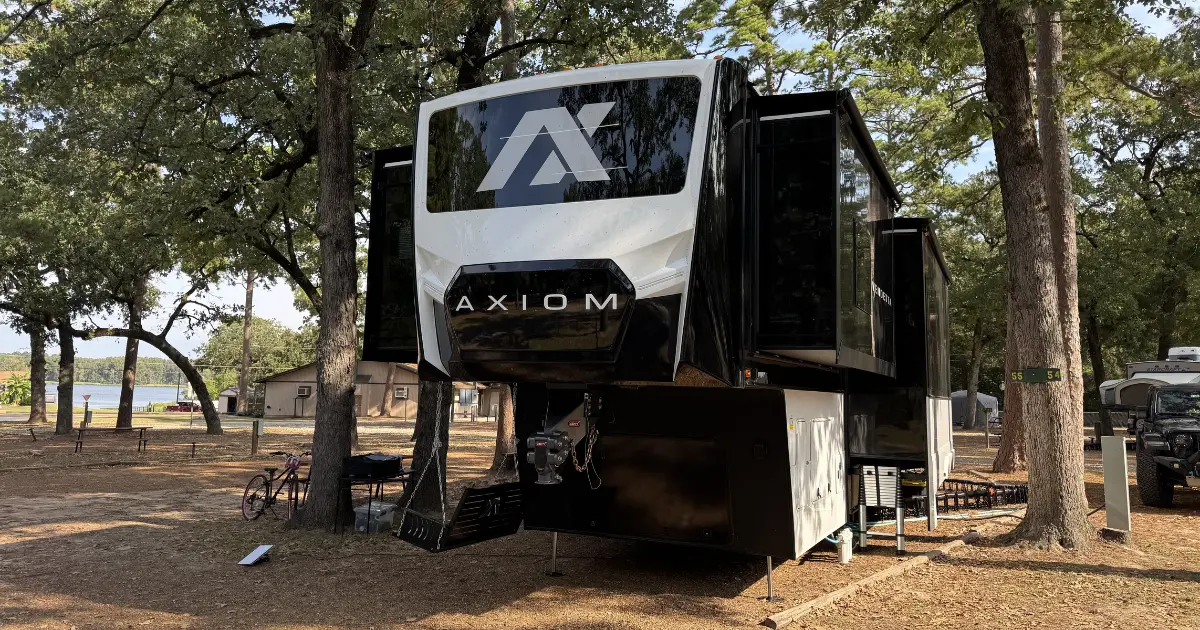
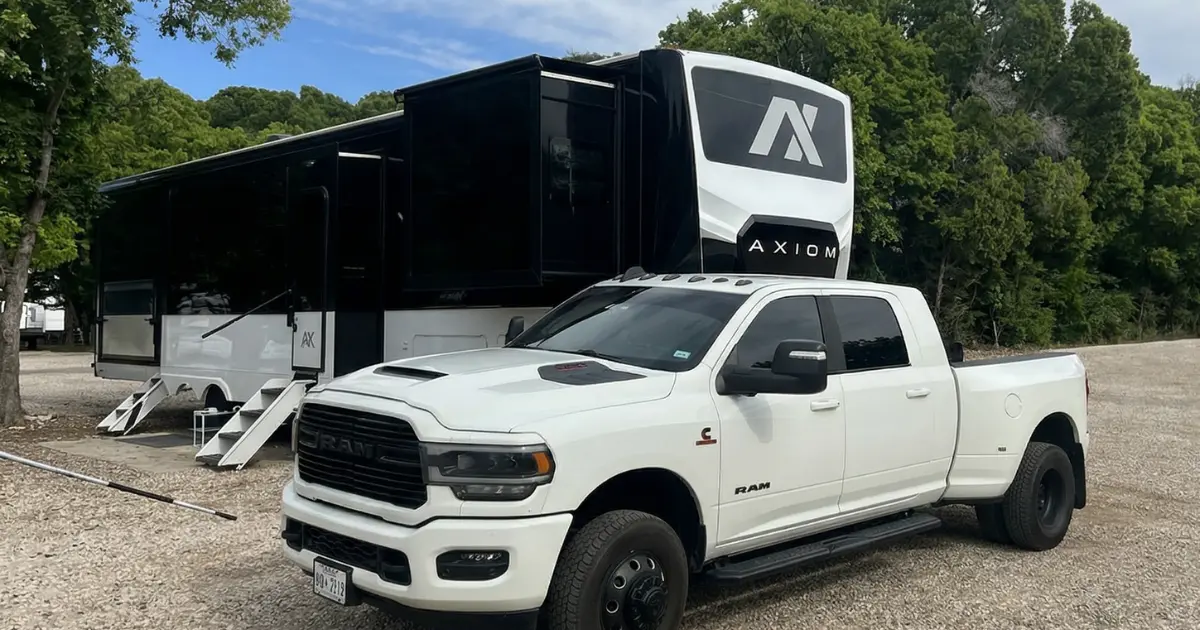
Short version: toy hauler fifth wheels have big pros (a whole second room, a real garage, flexible use) and real cons (heavier tow, worse fuel economy, tighter campground fit, a garage that cooks without proper cooling). We moved our family of four into an Axiom Vendetta 4250 toy hauler in October 2025. The pros are in our full-time family life post. This post is the other side: the 4 trade-offs every buyer should know before signing the paperwork.
- Toy Hauler Fifth Wheel Pros, in One Paragraph
- Quick Context: Who We Are and What We Tow
- The 4 Toy Hauler Fifth Wheel Trade-offs That Actually Matter
- Your Toy Hauler Tow Setup Is Half the Rig
- How to Pick a Toy Hauler Brand You Can Live With
- FAQ: Toy Hauler Tow Vehicle, Weight, and Buying Questions
- The Short Version
Toy Hauler Fifth Wheel Pros, in One Paragraph
Before we get into all of the toy hauler fifth wheel pros and cons, here are the pros in compressed form: a fifth wheel toy hauler gives a full-time family a second room, a flexible garage bay that becomes a schoolroom, office, playroom, or guest room, more storage than a comparable bunkhouse, and a rig that handles rain days, work calls, and overflow guests without the usual one-room shuffle. We wrote the long version of the pros in Fifth Wheel Toy Hauler for Full-Time Family Life: 5 Problems It Solved. Everything below is the other side of that story.
Quick Context: Who We Are and What We Tow
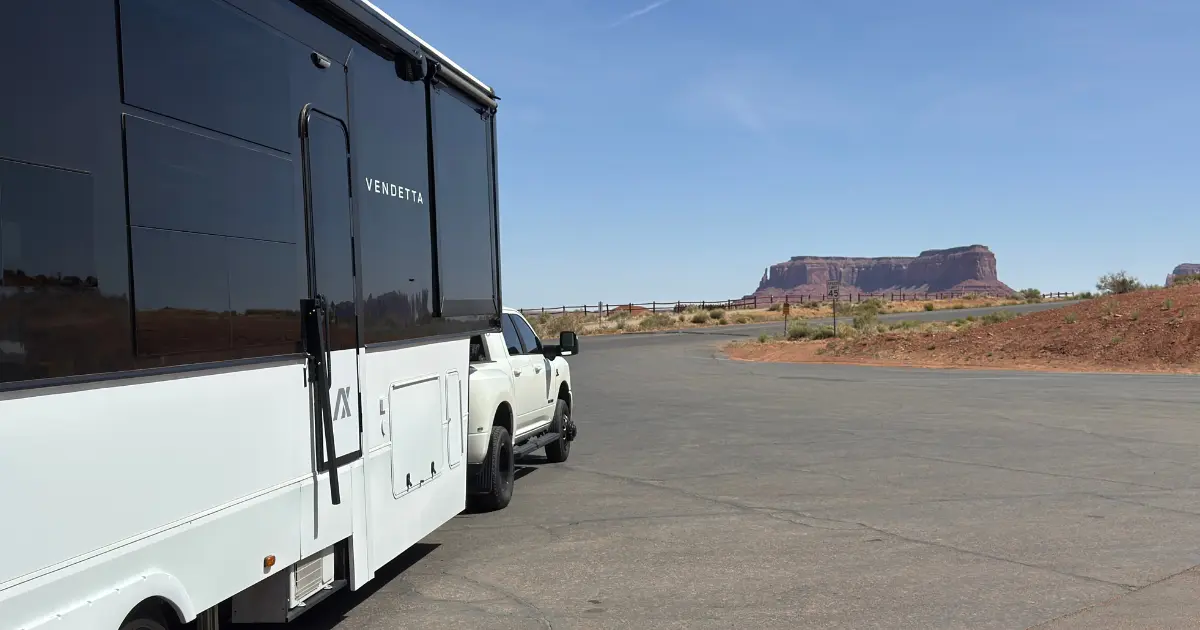
If you’re new here: we’re the Lawings, a family of four full-timing since August 2024. We started in a bunkhouse fifth wheel, traded into an Axiom Vendetta 4250 toy hauler in October 2025, and we pull it with a Ram 3500 dually.
This post is what we wish someone had walked us through in a calm voice before we put down a deposit on a toy hauler fifth wheel.
The 4 Toy Hauler Fifth Wheel Trade-offs That Actually Matter
1. Toy Hauler Weight (and Why Your Truck Is Probably the Deciding Factor)
Toy haulers are heavier than comparable bunkhouses. The garage framing, the ramp door, the extra axle, and the reinforced floor all add up. A bunkhouse fifth wheel in the 38-foot range might come in around 12,000 to 13,000 lbs dry. A toy hauler at the same length routinely runs 14,000 to 16,000 lbs dry, and dry numbers are a fantasy once you load a family’s life into it.
The truck is the first real decision, not the rig. If you’re in a half-ton (F-150, Silverado 1500, Ram 1500) or a short-bed three-quarter-ton, a toy hauler fifth wheel is probably off the table without a truck upgrade. Check your truck’s payload sticker in the driver’s door jamb, estimate the pin weight of the rig you’re looking at (usually 20 to 25 percent of loaded weight), and add passengers, gear, and hitch weight. If that total is over your payload, it doesn’t matter how clever the floor plan is.
We tow with a Ram 3500 dually, and even with that much truck under us, we weighed the loaded rig at a CAT scale before we hit the road. Its a must. CAT scales are about $13 and tell you what every sticker won’t.
2. Toy Hauler Fuel Economy
Heavier rig, worse mpg. Compared to our old bunkhouse, we lost roughly 1 to 2 mpg on long hauls. Over the course of a year of full-time miles, that’s a real line on the spreadsheet. We planned for it by adjusting our travel cadence (longer stays, fewer moves) and it’s mostly absorbed into the budget now, but it’s not nothing. If you’re already driving every week, this cost adds up fast.
3. Toy Hauler Length and Campground Fit
Our Vendetta is 47 feet. That number closes doors.
Plenty of state park sites top out at 35 or 40 feet. Lots of national forest campgrounds are tighter than that. Corps of Engineers (COE) campgrounds are often built around shorter rigs. We now filter campground searches by length limit before we even look at the pictures, and we’ve passed on spots we would have booked in the old rig.
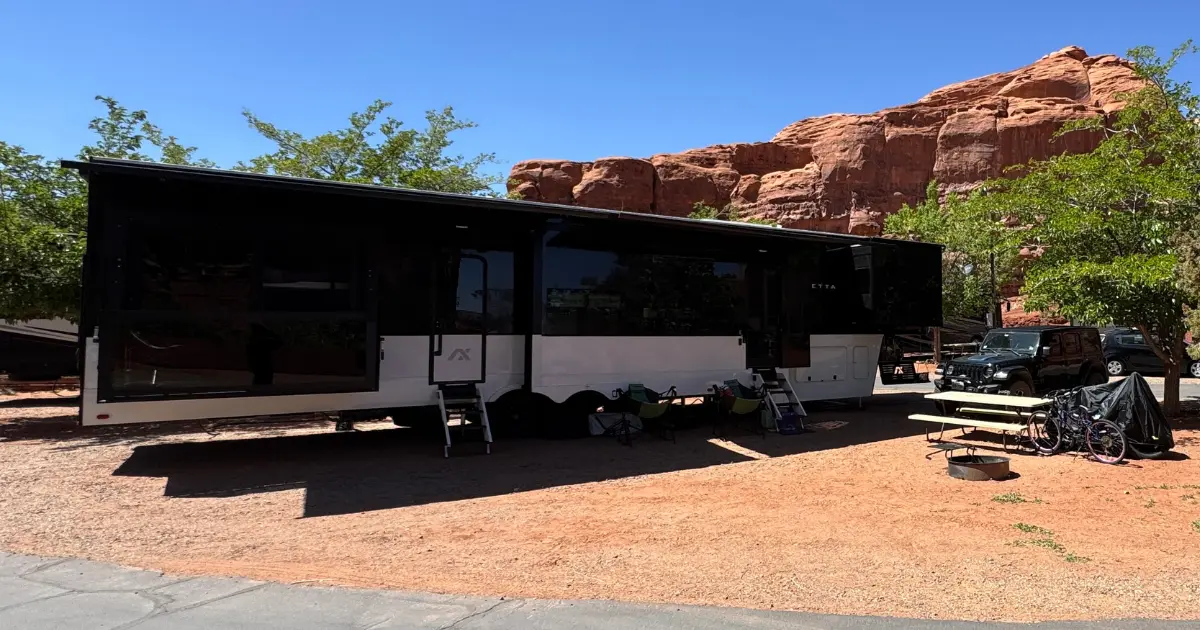
Some private parks and KOAs are fine. Most public land is where this bites. If boondocking on forest roads or camping deep in the state park system is central to your plan, a 47-foot rig will limit you. Shorter toy haulers exist (some brands have 34 to 38-foot floor plans), so this is solvable, but it’s solvable by choosing the right length up front, not by wishing your rig were smaller later.
4. Toy Hauler Garage Heat in Summer
This is the trade-off everyone asks about and the one with the clearest answer.
A toy hauler garage is a big uninsulated metal box with a ramp door. Left alone in July, it cooks. The skeptics aren’t wrong about that picture. They’re just wrong about the ending.
The fix is a dedicated mini-split AC for the garage bay in addition to the main living area’s system. Our Vendetta came with one. With it running, the garage holds temperature through 100-plus-degree Texas afternoons, and we’ve worked, schooled, and slept out there without issue. Without a dedicated garage unit, the main AC can’t keep up and you’ll hate life.
If you’re shopping toy haulers, treat a dedicated garage AC as a must-have spec for full-time summer habitation. If the floor plan you love doesn’t have one, price out an aftermarket install before you buy, and budget for it.
Your Toy Hauler Tow Setup Is Half the Rig
A lot of families buy the RV and then figure out the hitch. We did it backwards and we’d do it that way again.
Before the Vendetta hit a road, we upgraded to a GenY Executive Gooseneck. hitch, a gooseneck coupler with a built-in torsion shock that replaces the stock fifth wheel pin box. Two things sold us on it, and six months in both are still true.
It frees up the truck bed. A traditional fifth wheel hitch lives in the middle of the bed year-round. The GenY Executive drops into the factory gooseneck ball, which means the bed clears out the second we unhitch. No rails, no base plate, no weekend of unbolting a heavy hitch to haul plywood or load a dirt bike. For a family that uses the truck as a truck, that’s a big deal.
It rides fantastic and doesn’t chuck. Chucking is the back-and-forth jerk you feel through the cab at low speeds and stoplights with a loaded fifth wheel. The GenY Executive’s torsion shock absorbs the slack instead of punching it through the truck. Chip-seal, expansion joints, washboard gravel, all of it comes through softer. We noticed the difference on the first highway pull, and the kids noticed it in the back seat.
A few things we’d tell anyone towing a heavy fifth wheel:
- Size the hitch for the rig you have. Whatever’s sitting in your truck bed right now may be under-rated for a loaded toy hauler. A great RV behind an under-spec hitch is a bad time. B&W Companion, Curt A25, and PullRite SuperGlide are all widely respected. Give yourself capacity headroom.
- Weigh the loaded rig. Every full-timer should know their loaded pin weight, axle weights, and gross combined weight. CAT scales cost about $13. The answers shape tire pressure, tow speed, and whether you’re safe.
- Tire pressure matters more than you think. Underinflated RV tires in hot weather are how most blowouts happen. We check cold pressures every travel day. TPMS (tire pressure monitoring) on all six trailer tires is cheap insurance.
“Towing capacity” and “payload” are two different numbers, and payload is the one that usually gets exceeded with a heavy fifth wheel. Check the yellow sticker inside the driver’s door jamb, not the marketing brochure.
How to Pick a Toy Hauler Brand You Can Live With
The toy hauler segment has a wide quality spread. The same floor plan at the same length can be built three different ways, and the one you get matters more than the brand name on the door.
Here’s what we looked for when we walked floor plans:
- Slide mechanisms. Open and close every slide on the lot unit. Listen. Watch. Look at the slide topper. If the dealer gets nervous about you cycling slides, that’s the answer.
- Water system access. Can you get to the pump, the water heater bypass, and the winterize valves without disassembling a cabinet? You will do this many, many times. A well-laid-out plumbing bay is the sign of a builder who’s actually lived in one.
- Garage wall construction. Is the garage floor and wall built out of the same materials as the rest of the rig, or is it lighter? Look at the tie-downs, the D-rings, and the ramp door hinges. You want the garage built like a garage, not like an afterthought.
- Dealer candor. Ask the salesperson what’s the first thing that typically breaks. If they say “nothing,” walk.
We went with Axiom because the build quality held up to the walk-through and a few tough questions. It’s not the cheapest option in the segment. It’s the one we stopped worrying about. You can read Axiom’s own spec sheet on the Vendetta product page, and if you want to talk to the same dealer we used, our Axiom info request page routes you through us.
FAQ: Toy Hauler Tow Vehicle, Weight, and Buying Questions
Can I tow a toy hauler fifth wheel with a half-ton truck?
Probably not, once the rig is loaded. Half-tons can handle some smaller bumper-pull toy haulers, but a 35-foot-plus fifth wheel with a loaded garage will exceed payload for nearly every half-ton on the road. Check payload, not just towing capacity. Those are two different numbers.
How much does pin weight matter?
A lot. Pin weight is the amount of the trailer’s weight sitting on your truck’s rear axle, and it’s the spec that most often blows past payload. For a loaded toy hauler, budget 20 to 25 percent of trailer weight as pin weight, and add passengers and gear on top. That total needs to live under your truck’s payload rating.
Is a dually necessary, or is a single rear wheel enough?
A single-rear-wheel (SRW) three-quarter or one-ton can tow some toy haulers safely. A dually adds margin, stability in crosswinds, and more rear payload. We went dually because we were already planning to go heavy, and we haven’t regretted it. If you’re at the edge of SRW payload, move up.
What mpg does a toy hauler actually get?
Expect 7 to 10 mpg with a diesel one-ton, depending on terrain and wind. Our Ram 3500 pulls the Vendetta at around 8-9 mpg average, down roughly 1 to 2 mpg versus the bunkhouse we had before.
Do toy haulers hold their value?
Toy haulers have a loyal buyer base and a specific resale market (families, weekend haulers, work-site buyers). In our limited experience, resale tracks the broader fifth-wheel market more than the bunkhouse premium falling off. Brand and condition matter more than segment.
What should I budget for the hitch and tow setup?
Plan for $500 to $2,500 on top of the truck, depending on whether you’re buying the hitch, a better pin box, a TPMS system, and any suspension upgrades. Don’t skip the TPMS.
The Short Version
A toy hauler fifth wheel is not a magic box. It’s heavier, longer, thirstier, and hotter than the bunkhouse your friend is full-timing in. If you’re clear-eyed about those trade-offs, it’s one of the most livable RVs on the road for a family. If you skip them, you’ll end up in a rig that doesn’t fit your truck or your campground reservations.
The trade-offs aren’t reasons not to buy one. They’re reasons to buy the right one. Match the length to where you want to camp, match the truck to the rig, and don’t skimp on the hitch.
If you want the other side of this story, the family life side, Fifth Wheel Toy Hauler for Full-Time Family Life: 5 Problems It Solved covers why we made the switch in the first place.
If you want to talk to the dealer we worked with, fill out our Axiom info request form. As an Axiom Ambassador, I’ll route you to the nearest trusted dealership and answer real questions about our Vendetta 4250.
Your turn. Shopping toy haulers right now? Already in one and running into a trade-off I didn’t cover? Leave a comment with what you’re looking at (or towing). We answer every one, and it helps the next family that lands on this post.